Feature | Description |
Performance |
Switching capacity and
forwarding rate | Model Name | Capacity in Millions of Packets per Second (mpps) (64-byte packets) | Switching Capacity in Gigabits per Second (Gbps) |
SF300-08 | 1.19 | 1.6 |
SF302-08 | 4.17 | 5.6 |
SF302-08P | 4.17 | 5.6 |
SF302-08MP | 4.17 | 5.6 |
SF300-24 | 9.52 | 12.8 |
SF300-24P | 9.52 | 12.8 |
SF300-48 | 13.10 | 17.6 |
SF300-48P | 13.10 | 17.6 |
SG300-10 | 14.88 | 20.0 |
SG300-10P | 14.88 | 20.0 |
SG300-10MP | 14.88 | 20.0 |
SG300-20 | 29.76 | 40.0 |
SG300-28 | 41.67 | 56.0 |
SG300-28P | 41.67 | 56.0 |
SG300-52 | 77.38 | 104.0 |
Layer 2 Switching |
Spanning Tree Protocol (STP) | Standard 802.1d Spanning Tree support Fast convergence using 802.1w (Rapid Spanning Tree [RSTP]), enabled by default 16 instances are supported Multiple Spanning Tree instances using 802.1s (MSTP) |
Port grouping | Support for IEEE 802.3ad Link Aggregation Control Protocol (LACP) Up to 8 groups Up to 8 ports per group with 16 candidate ports for each (dynamic) 802.3ad link aggregation |
VLAN | Support for up to 4096 VLANs simultaneously Port-based and 802.1Q tag-based VLANs MAC-based VLAN Management VLAN Private VLAN Edge (PVE), also known as protected ports, with multiple uplinks Guest VLAN Unauthenticated VLAN Dynamic VLAN assignment via Radius server along with 802.1x client authentication Protocol-based VLAN CPE VLAN |
Voice VLAN | Voice traffic is automatically assigned to a voice-specific VLAN and treated with appropriate levels of QoS Auto voice capabilities deliver network-wide zero touch deployment of voice endpoints and call control devices. |
Multicast TV VLAN | Multicast VLAN used for video applications (Also known as MVR) |
Q-in-Q VLAN | VLANs transparently cross a service provider network while isolating traffic among customers |
Generic VLAN Registration Protocol (GVRP)/Generic Attribute Registration Protocol (GARP) | Protocols for automatically propagating and configuring VLANs in a bridged domain |
Dynamic Host Configuration Protocol (DHCP) Relay at Layer 2 | Relay of DHCP traffic to DHCP server in different VLAN. Works with DHCP Option 82 |
Internet Group Management Protocol (IGMP) versions 1, 2, and 3 snooping | IGMP
limits bandwidth-intensive multicast traffic to only the requesters;
supports 1K multicast groups (source-specific multicasting is also
supported) |
IGMP Querier | IGMP querier is used to support a Layer 2 multicast domain of snooping switches in the absence of a multicast router. |
Head-of-line (HOL) blocking | HOL blocking prevention |
Jumbo Frames | Up to 10K in length |
Layer 3 |
IPv4 routing | Wirespeed routing of IPv4 packets Up to 32 static routes and up to 32 IP interfaces |
Classless Inter-Domain Routing (CIDR) | Support for CIDR |
DHCP relay at Layer 3 | Relay of DHCP traffic across IP domains |
User Datagram Protocol (UDP) relay | Relay of broadcast information across Layer 3 domains for application discovery or relaying of BootP/DHCP packets |
Security |
Secure Shell (SSH) Protocol | SSH is a secure replacement for Telnet traffic. SCP also uses SSH. SSH v1 and v2 are supported |
Secure Sockets Layer (SSL) | SSL support: Encrypts all HTTPS traffic, allowing highly secure access to the browser-based management GUI in the switch |
IEEE 802.1X
(Authenticator role) | 802.1X:
RADIUS authentication and accounting, MD5 hash; guest VLAN;
unauthenticated VLAN, single/multiple host mode and single/multiple
sessions Supports time-based 802.1X Dynamic VLAN assignment |
STP Bridge Protocol Data Unit (BPDU) Guard | A
security mechanism to protect the network from invalid configurations. A
port enabled for BPDU Guard is shut down if a BPDU message is received
on that port |
STP Root Guard | Prevents
a port from being selected as a root port, effectively preventing
bridges in the LAN segment connected to the port from being a root
bridge. |
DHCP snooping | Filters
out DHCP messages with unregistered IP addresses and/or from unexpected
or untrusted interfaces. This prevents rogue devices from behaving as a
DHCP Server. |
IP Source Guard (IPSG) | When
IP Source Guard is enabled at a port, the switch filters out IP packets
received from the port if the source IP addresses of the packets have
not been statically configured or dynamically learned from DHCP
snooping. This prevents IP Address Spoofing. |
Dynamic ARP Inspection (DAI) | The
switch discards ARP packets from a port if there is no static or
dynamic IP/MAC bindings or if there is a discrepancy between the source
or destination address in the ARP packet. This prevents
man-in-the-middle attacks. |
IP/Mac/Port Binding (IPMB) | The
features (DHCP Snooping, IP Source Guard, and Dynamic ARP Inspection)
above work together to prevent DOS attacks in the network, thereby
increasing network availability |
Secure Core Technology (SCT) | Ensures that the switch will receive and process management and protocol traffic no matter how much traffic is received |
Secure Sensitive Data (SSD) | A
mechanism to manage sensitive data (such as passwords, keys, etc)
securely on the switch, populating this data to other devices, and
secure autoconfig. Access to view the sensitive data as plaintext or
encrypted is provided according to the user configured access level and
the access method of the user. |
Layer 2 isolation Private VLAN Edge (PVE) with community VLAN | PVE (also known as protected ports) provides Layer 2 isolation between devices in the same VLAN, supports multiple uplinks |
Port security | Locks MAC addresses to ports, and limits the number of learned MAC addresses |
RADIUS/TACACS+ | Supports RADIUS and TACACS authentication. Switch functions as a client |
Storm control | Broadcast, multicast, and unknown unicast |
RADIUS accounting | The
RADIUS accounting functions allow data to be sent at the start and end
of services, indicating the amount of resources (such as time, packets,
bytes, and so on) used during the session. |
DoS prevention | DoS attack prevention |
Congestion avoidance | A TCP congestion avoidance algorithm is required to minimize and prevent global TCP loss synchronization. |
ACLs | Support for up to 512 rules Drop
or rate limit based on source and destination MAC, VLAN ID or IP
address, protocol, port, differentiated services code point (DSCP)/IP
precedence, TCP/ UDP source and destination ports, 802.1p priority,
Ethernet type, Internet Control Message Protocol (ICMP) packets, IGMP
packets, TCP flag, Time-based ACLs supported |
Quality of Service |
Priority levels | 4 hardware queues |
Scheduling | Strict priority and weighted round-robin (WRR) Queue assignment based on DSCP and class of service (802.1p/CoS) |
Class of service | Port
based; 802.1p VLAN priority based; IPv4/v6 IP precedence/type of
service (ToS)/DSCP based; Differentiated Services (DiffServ);
classification and re-marking ACLs, trusted QoS |
Rate limiting | Ingress policer; egress shaping and rate control; per VLAN, per port, and flow based |
Standards |
Standards | IEEE
802.3 10BASE-T Ethernet, IEEE 802.3u 100BASE-TX Fast Ethernet, IEEE
802.3ab 1000BASE-T Gigabit Ethernet, IEEE 802.3ad LACP, IEEE 802.3z
Gigabit Ethernet, IEEE 802.3x Flow Control, IEEE 802.1D (STP, GARP, and
GVRP),IEEE 802.1Q/p VLAN, IEEE 802.1w RSTP, IEEE 802.1s Multiple STP,
IEEE 802.1X Port Access Authentication, IEEE 802.3af, IEEE 802.3at, RFC
768, RFC 783, RFC 791, RFC 792, RFC 793, RFC 813, RFC 879, RFC 896, RFC
826, RFC 854, RFC 855, RFC 856, RFC 858, RFC 894, RFC 919, RFC 922, RFC
920, RFC 950, RFC 951, RFC 1042, RFC 1071, RFC 1123, RFC 1141, RFC 1155,
RFC 1157, RFC 1350, RFC 1533, RFC 1541, RFC 1542, RFC 1624, RFC 1700,
RFC 1867, RFC 2030, RFC 2616, RFC 2131, RFC 2132, RFC 3164, RFC 3411,
RFC 3412, RFC 3413, RFC 3414, RFC 3415, RFC 2576, RFC 4330, RFC 1213,
RFC 1215, RFC 1286, RFC 1442, RFC 1451, RFC 1493, RFC 1573, RFC 1643,
RFC 1757, RFC 1907, RFC 2011, RFC 2012, RFC 2013, RFC 2233, RFC 2618,
RFC 2665, RFC 2666, RFC 2674, RFC 2737, RFC 2819, RFC 2863, RFC 1157,
RFC 1493, RFC 1215, RFC 3416 |
IPv6 |
IPv6 | IPv6 host mode IPv6 over Ethernet Dual IPv6/IPv4 stack IPv6 neighbor and router discovery (ND) IPv6 stateless address auto-configuration Path maximum transmission unit (MTU) discovery Duplicate address detection (DAD) ICMP version 6 IPv6 over IPv4 network with Intra-Site Automatic Tunnel Addressing Protocol (ISATAP) support USGv6 and IPv6 Gold Logo certified |
IPv6 QoS | Prioritize IPv6 packets in hardware |
IPv6 ACL | Drop or rate limit IPv6 packets in hardware |
Multicast Listener Discovery (MLD) snooping | Deliver IPv6 multicast packets only to the required receivers |
IPv6 applications | Web/SSL,
Telnet server/SSH, ping, traceroute, Simple Network Time Protocol
(SNTP), Trivial File Transfer Protocol (TFTP), SNMP, RADIUS, syslog, DNS
client, protocol-based VLANs |
IPv6 RFCs supported | RFC 2463 - ICMP version 6 RFC 3513 - IPv6 address architecture RFC 4291 - IPv6 addressing architecture RFC 2460 - IPv6 specification RFC 2461 - Neighbor discovery for IPv6 RFC 2462 - IPv6 stateless address auto-configuration RFC 1981 - Path MTU discovery RFC 4007 - IPv6 scoped address architecture RFC 3484 - Default address selection mechanism RFC 4214 - ISATAP tunneling RFC 4293 - MIB IPv6: Textual conventions and general group RFC 3595 - Textual conventions for IPv6 flow label |
Management |
Web user interface | Built-in
switch configuration utility for easy browser-based device
configuration (HTTP/HTTPS). Supports configuration, system dashboard,
system maintenance, and monitoring |
SNMP | SNMP versions 1, 2c, and 3 with support for traps, and SNMP version 3 user-based security model (USM) |
Standard MIBs | BRIDGE-MIB DIFFSERV-DSCP-TC DIFF-SERV-MIB DISMAN-NSLOOKUP-MIB DISMAN-PING-MIB DISMAN-TRACEROUTE-MIB DNS-RESOLVER-MIB DNS-SERVER-MIB DRAFT-IETF-SYSLOG-DEVICE-MIB ENTITY-MIB ENTITY-SENSOR-MIB EtherLike-MIB EtherLike-MIB IANA-ADDRESS-FAMILY-NUMBERS-MIB IANAifType-MIB IANA-RTPROTO-MIB IEEE8021-PAE-MIB IEEE9023-LAG-MIB IF-MIB INET-ADDRESS-MIB IP-FORWARD-MIB IP-MIB IP-MIB LLDP-EXT-DCBX-MIB.mib LLDP-EXT-DOT1-MIB LLDP-EXT-DOT3-MIB LLDP-EXT-MED-MIB LLDP-MIB MAU-MIB OSPF-MIB OSPF-TRAP-MIB P-BRIDGE-MIB | POWER-ETHERNET-MIB Q-BRIDGE-MIB Q-BRIDGE-MIB RADIUS-ACC-CLIENT-MIB RADIUS-AUTH-CLIENT-MIB RFC1155-SMI RFC-1212 RFC1213-MIB RFC-1215 RFC1389-MIB RMON2-MIB RMON-MIB RSTP-MIB SMON-MIB SNMP-COMMUNITY-MIB SNMP-FRAMEWORK-MIB SNMP-MPD-MIB SNMP-NOTIFICATION-MIB SNMP-PROXY-MIB SNMP-TARGET-MIB SNMP-USER-BASED-SM-MIB SNMPv2-CONF SNMPv2-MIB SNMPv2-MIB SNMPv2-SMI SNMPv2-TC SNMPv2-TM SNMP-VIEW-BASED-ACM-MIB TCP-MIB TUNNEL-MIB UDP-MIB |
Private MIBs | CISCO-CDP-MIB CISCO-SMI CISCO-TC CISCO-VTP-MIB CISCOSB-1-BONJOUR-SERVICE-MIB CISCOSB-3SW2SWTABLES-MIB CISCOSB-AAA CISCOSB-BANNER-MIB CISCOSB-BaudRate-MIB CISCOSB-BONJOUR-MIB CISCOSB-BRGMACSWITCH-MIB CISCOSB-BRIDGEMIBOBJECTS-MIB CISCOSB-BRIDGE-SECURITY CISCOSB-CDB-MIB CISCOSB-CDP-MIB CISCOSB-CLI-MIB CISCOSB-COPY-MIB CISCOSB-CPU-COUNTERS-MIB CISCOSB-DEBUGCAPABILITIES-MIB CISCOSB-DEVICEPARAMS-MIB CISCOSB-DHCPCL-MIB CISCOSB-DHCP-MIB CISCOSB-Dlf-MIB CISCOSB-DNSCL-MIB CISCOSB-DOT1X-MIB CISCOSB-EEE-MIB CISCOSB-EMBWEB-MIB CISCOSB-ENDOFMIB-MIB CISCOSB-ERRDISABLE-RECOVERY-MIB CISCOSB-EVENTS-MIB CISCOSB-File CISCOSB-GREEN-MIB CISCOSB-GVRP-MIB CISCOSB-HWENVIROMENT CISCOSB-IP CISCOSB-IpRouter CISCOSB-IPv6 CISCOSB-JUMBOFRAMES-MIB CISCOSB-LLDP-MIB CISCOSB-LOCALIZATION-MIB CISCOSB-MAC-BASE-PRIO CISCOSB-MIB CISCOSB-MIR-MIB | CISCOSB-MNGINF-MIB CISCOSB-MULTISESSIONTERMINAL-MIB CISCOSB-PHY-MIB CISCOSB-Physicaldescription-MIB CISCOSB-POE-MIB CISCOSB-POLICY-MIB CISCOSB-ProtectedPorts-MIB CISCOSB-QOS-CLI-MIB CISCOSB-rlBrgMcMngr-MIB CISCOSB-rlBrgMulticast-MIB CISCOSB-rlFft CISCOSB-rlInterfaces CISCOSB-rlLcli-MIB CISCOSB-RMOB CISCOSB-rndApplications CISCOSB-rndMng CISCOSB-SCT-MIB CISCOSB-SECURITY-SUITE CISCOSB-SENSORENTMIB CISCOSB-SMARTPORTS-MIB CISCOSB-SMON-MIB CISCOSB-SNMP-MIB CISCOSB-SOCKET-MIB CISCOSB-SpecialBpdu-MIB CISCOSB-SSH-MIB CISCOSB-SSL CISCOSB-STORMCTRL-MIB CISCOSB-SYSLOG-MIB CISCOSB-SYSMNG-MIB CISCOSB-TBI-MIB CISCOSB-TCPSESSIONS CISCOSB-TELNET-MIB CISCOSB-TIMESYNCHRONIZATION-MIB CISCOSB-TRACEROUTE-MIB CISCOSB-TRAPS-MIB CISCOSB-TRUNK-MIB CISCOSB-TUNNEL-MIB CISCOSB-Tunning CISCOSB-UDP CISCOSB-vlan-MIB CISCOSB-vlanVoice-MIB CISCOSB-WeightedRandomTailDrop-MIB CISCOSMB-MIB |
Remote Monitoring (RMON) | Embedded
RMON software agent supports 4 RMON groups (history, statistics,
alarms, and events) for enhanced traffic management, monitoring, and
analysis |
IPv4 and IPv6 dual stack | Coexistence of both protocol stacks to ease migration |
Firmware upgrade | Web browser upgrade (HTTP/HTTPS) and TFTP Upgrade can be initiated through console port as well Dual images for resilient firmware upgrades |
Port mirroring | Traffic
on a port can be mirrored to another port for analysis with a network
analyzer or RMON probe. Up to 8 source ports can be mirrored to one
destination port. A single session is supported. |
VLAN mirroring | Traffic
from a VLAN can be mirrored to a port for analysis with a network
analyzer or RMON probe. Up to 8 source VLANs can be mirrored to one
destination port. A single session is supported. |
DHCP (Options 12, 66, 67, 82, 129, and 150) | DHCP
Options facilitate tighter control from a central point (DHCP server)
to obtain IP address, auto-configuration (with configuration file
download), DHCP relay, and hostname |
Secure Copy (SCP) | Securely transfer files to and from the switch. |
Autoconfiguration with Secure Copy (SCP) file download | Enables secure mass deployment with protection of sensitive data. |
Text-editable config files | Config files can be edited with a text editor and downloaded to another switch, facilitating easier mass deployment |
Smartports | Simplified configuration of QoS and security capabilities |
Auto Smartports | Applies
the intelligence delivered through the Smartport roles and applies it
automatically to the port based on the devices discovered over CDP or
LLDP-MED. This facilitates zero touch deployments. |
Textview CLI | Scriptable command-line interface. A full CLI as well as a menu-based CLI is supported |
Cloud services | Support for Cisco Small Business FindIT Network and Cisco OnPlus |
Localization | Localization of GUI and documentation into multiple languages |
Other management | Traceroute;
single IP management; HTTP/HTTPS; SSH; RADIUS; port mirroring; TFTP
upgrade; DHCP client; BOOTP; SNTP; Xmodem upgrade; cable diagnostics;
ping; syslog; Telnet client (SSH secure support) |
Time-based port operation | Link up or down based on user-defined schedule (when the port is administratively up). |
Login banner | Configurable login banners for web as well as CLI. |
Power Efficiency |
EEE Compliant (802.3az) | Supports 802.3az on all copper ports (SG300 models). |
Energy Detect | Automatically turns off power off on Gigabit Ethernet and 10/100 RJ-45 port when detecting link down Active mode is resumed without loss of any packets when the switch detects the link up |
Cable length detection | Adjusts
the signal strength based on the cable length for Gigabit Ethernet
models. Reduces the power consumption for cables shorter than 10m. |
Disable port LEDs | LEDs can be manually turned off to save on Energy |
General |
Jumbo frames | Frame sizes up to 10 KB supported on 10/100 and Gigabit interfaces |
MAC table | Up to 16000 MAC addresses |
Discovery |
Bonjour | The switch advertises itself using the Bonjour protocol. |
Link Layer Discovery Protocol (LLDP) (802.1ab) with LLDP-MED extensions | LLDP
allows the switch to advertise its identification, configuration, and
capabilities to neighboring devices that store the data in a MIB.
LLDP-MED is an enhancement to LLDP that adds the extensions needed for
IP phones. |
Cisco Discovery Protocol | The switch advertises itself using the Cisco Discovery Protocol. |
Power over Ethernet (PoE) |
IEEE 802.3af PoE delivered over any of the RJ-45 ports within the listed power budgets | Maximum power of 15.4W to any 10/100 or Gigabit Ethernet base port. The total power available for PoE per switch is as follows: |
Model Name | Power Dedicated to PoE | Number of Ports That Support PoE |
SF302-08P | 62W | 8 |
SF302-08MP | 124W | 8 |
SF300-24P | 180W | 24 |
SF300-48P | 375W | 48 |
SG300-10P | 62W | 8 |
SG300-10MP | 124W | 8 |
SG300-28P | 180W | 24 |
Power consumption | Model Name | Power Savings Mode | System Power Consumption | Power Consumption: Case (with POE) | Heat Dissipation Worst Case (BTU/hr) |
SF300-08 | Energy Detect | 110V=6.1W
220V=7.2W | N/A | 24.57 |
SF302-08 | Energy Detect | 110V=8.0W
220V=8.6W | N/A | 29.34 |
SF302-08P | Energy Detect | 110V=10.3W
220V=11.5W | 110V=81.3W
220V=82.1W | 280.13 |
SF302-08MP | Energy Detect | 110V=9.5W
220V=10.3W | 110V=150.1W
220V=149.9W | 512.14 |
SF300-24 | Energy Detect | 110V=16.4W
220V=17.1W | N/A | 58.35 |
SF300-24P | Energy Detect | 110V=25.8W
220V=27.3W | 110V=223W
220V=217.9W | 760.88 |
SF300-48 | Energy Detect | 110V=24W
220V=24.8W | N/A | 84.62 |
SF300-48P | Energy Detect | 110V=46.4W
220V=46.3W | 110V=465W
220V=449W | 1531.99 |
SG300-10 | Energy Detect
Short Reach | 110V=10.33W
220V=10.27W | N/A | 35.25 |
SG300-10P | Energy Detect
Short Reach | 110V=13.13W
220V=13.48W | 110V=81.44W
220V=81.16W | 277.87 |
SG300-10MP | Energy Detect
Short Reach | 110V=12.21W
220V=12.25W | 110V=154.36W
220V=152.42W | 526.68 |
SG300-20 | Energy Detect
Short Reach | 110V=16.05W
220V=16.26W | N/A | 55.48 |
SG300-28 | Energy Detect
Short Reach | 110V=19.8W
220V=20.6W | N/A | 70.29 |
SG300-28P | Energy Detect
Short Reach | 110V=29.7W
220V=30.7W | 110V=214.4W
220V=210W | 731.53 |
SG300-52 | Energy Detect
Short Reach | 110V=45.9W
220V=45.3W | N/A | 156.61 |
Ports | Model Name | Total System Ports | RJ-45 Ports | Combo Ports
(RJ-45 + SFP) |
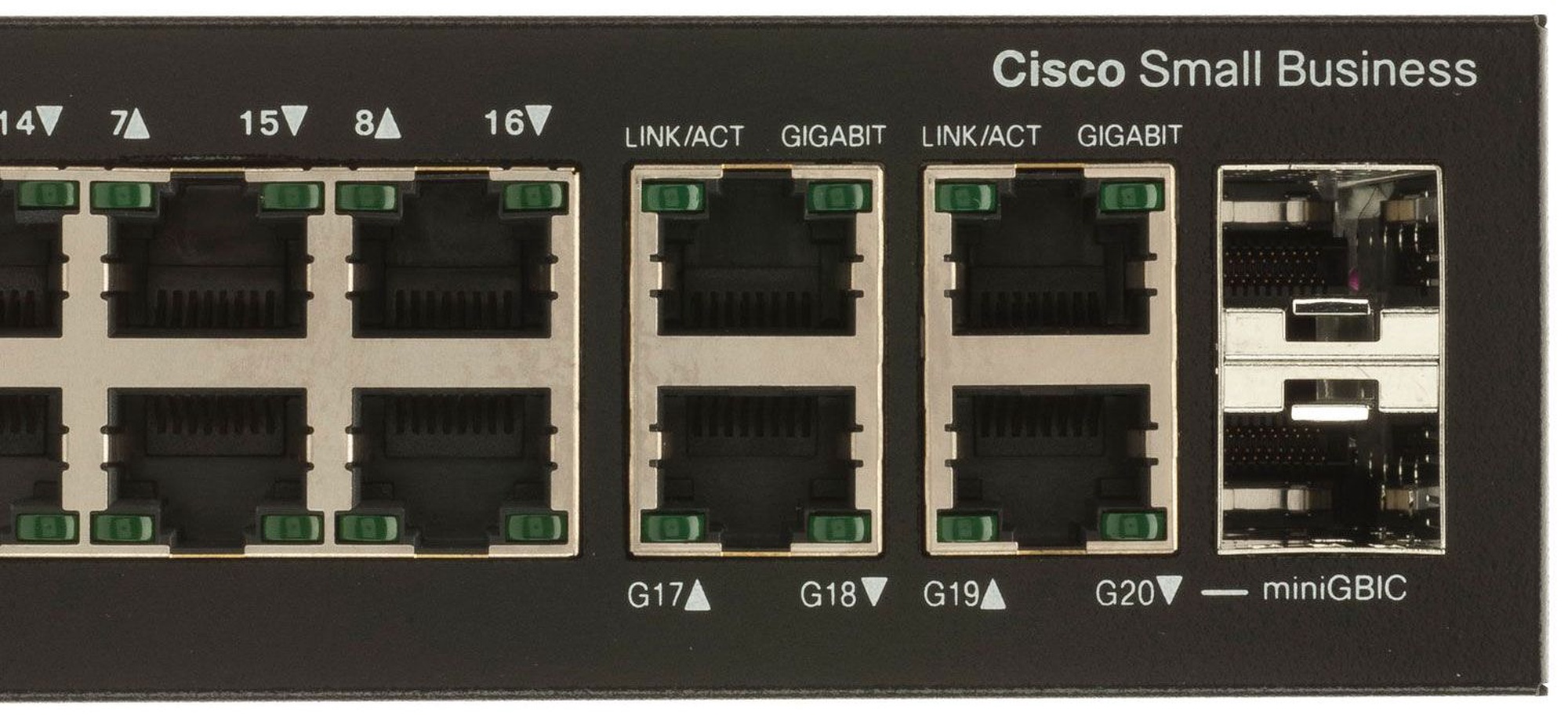
SG300-20 | 20 Gigabit Ethernet | 18 Gigabit Ethernet | 2 Gigabit Ethernet combo |
SG300-28 | 28 Gigabit Ethernet | 26 Gigabit Ethernet | 2 Gigabit Ethernet combo |
SG300-28P | 28 Gigabit Ethernet | 26 Gigabit Ethernet | 2 Gigabit Ethernet combo |
SG300-52 | 52 Gigabit Ethernet | 50 Gigabit Ethernet | 2 Gigabit Ethernet combo |
SF300-24 | 24 Fast Ethernet + 4 Gigabit Ethernet | 24 Fast Ethernet
2 Gigabit Ethernet | 2 Gigabit Ethernet combo |
SF300-24P | 24 Fast Ethernet + 4 Gigabit Ethernet | 24 Fast Ethernet
2 Gigabit Ethernet | 2 Gigabit Ethernet combo |
SF300-48 | 48 Fast Ethernet + 4 Gigabit Ethernet | 48 Fast Ethernet
2 Gigabit Ethernet | 2 Gigabit Ethernet combo |
SF300-48P | 48 Fast Ethernet + 4 Gigabit Ethernet | 48 Fast Ethernet
2 Gigabit Ethernet | 2 Gigabit Ethernet combo |
SG300-10 | 10 Gigabit Ethernet | 8 Gigabit Ethernet | 2 Gigabit Ethernet combo |
SG300-10P | 10 Gigabit Ethernet | 8 Gigabit Ethernet | 2 Gigabit Ethernet combo |
SG300-10MP | 10 Gigabit Ethernet | 8 Gigabit Ethernet | 2 Gigabit Ethernet combo |
SF300-08 | 8 Fast Ethernet | 8 Fast Ethernet | N/A |
SF302-08 | 8 Fast Ethernet + 2 Gigabit Ethernet | 8 Fast Ethernet | 2 Gigabit Ethernet combo |
SF302-08P | 8 Fast Ethernet + 2 Gigabit Ethernet | 8 Fast Ethernet | 2 Gigabit Ethernet combo |
SF302-08MP | 8 Fast Ethernet + 2Gigabit Ethernet | 8 Fast Ethernet | 2 Gigabit Ethernet combo |
Buttons | Reset button |
Cabling type | Unshielded twisted pair (UTP) Category 5 or better for 10BASE-T/100BASE-TX; UTP Category 5 Ethernet or better for 1000BASE-T |
LEDs | System, Link/Act, PoE, Speed, LED power saving option |
Flash | 16 MB |
CPU memory | 128 MB |
Packet buffer | All numbers are aggregate across all ports as the buffers are dynamically shared: |
Model Name | Packet Buffer |
SG300-20 | 8 Mb |
SG300-10 | 8 Mb |
SG300-10P | 8 Mb |
SG300-10MP | 8 Mb |
SF300-08 | 8 Mb |
SF302-08 | 8 Mb |
SF302-08P | 8 Mb |
SF302-08MP | 8 Mb |
SG300-28 | 8 Mb |
SG300-28P | 8 Mb |
SG300-52 | 8 Mb*2 |
SF300-24 | 8 Mb |
SF300-24P | 8 Mb |
SF300-48 | 8 Mb*2 |
SF300-48P | 8 Mb*2 |
Supported SFP modules | SKU | Media | Speed | Typical Distance |
MFEFX1 | Multimode fiber | 100 Mbps | 2 km |
MFELX1 | Single-mode fiber | 100 Mbps | 10 km |
MFEBX1 | Single-mode fiber | 100 Mbps | 20 km |
MGBBX1 | Single-mode fiber | 1000 Mbps | 40 km |
MGBSX1 | Multimode fiber | 1000 Mbps | 300 m |
MGBLH1 | Single-mode fiber | 1000 Mbps | 40 km |
MGBLX1 | Single-mode fiber | 1000 Mbps | 10 km |
MGBT1 | UTP cat 5 | 1000 Mbps | 100 m |
Environmental |
Dimensions (W x H x D) | SF300-08, SF302-08, SF302-08P, SF302-08MP, SG300-10, SG300-10P, SG300-10MP
11 x 1.45 x 6.7 in. (279.4 x 44.45 x 170 mm) SG300-20
17.3 x 1.45 x 7.97 in. (440 x 44.45 x 202.5 mm) SF300-24, SF300-24P, SF300-48, SG300-28, SG300-28P, SG300-52
17.3 x 1.45 x 10.1 in. (440 x 44.45 x 257 mm) SF300-48P
17.3 x 1.45 x 13.78 in. (440 x 44.45 x 350 mm) |
Unit weight | SF300-08: 2.56 lb (1.16 kg) SF302-08: 2.6 lb (1.18 kg) SF302-08P: 2.67 lb (1.21 kg) SF302-08MP: 2.67 lb (1.21 kg) SG300-10: 2.56 lb (1.16 kg) SG300-10P: 2.73 lb (1.24 kg) SG300-10MP: 2.73 lb (1.24 kg) SG300-20: 4.78 lb (2.17 kg) SF300-24: 6.81 lb (3.09 kg) SF300-24P: 8.22 lb (3.73 kg) SF300-48: 7.47 lb (3.39 kg) SF300-48P: 12.94 lb (5.87 kg) SG300-24: 7.23 lb (3.28 kg) SG300-24P: 9.06 lb (4.11 kg) SG300-52 : 8.62 lb (3.91 kg) |
Power | 100-240V 47-63 Hz, internal, universal - SF300-24, SF300-24P, SG300-20, SG300-28,
SG300-28P, SG300-52 100-240V 50-60 Hz, 0.5A, external - SF300-08, SF302-08, SG300-10 100-240V 50-60 Hz, 2A, external - SF302-08P, SG300-10P 100-240V 50-60 Hz, 2.5A, external - SF302-08MP, SG300-10MP |
Certification | UL (UL 60950), CSA (CSA 22.2), CE mark, FCC Part 15 (CFR 47) Class A |
Operating temperature | 32° to 104°F (0° to 40°C) |
Storage temperature | -4° to 158°F (-20° to 70°C) |
Operating humidity | 10% to 90%, relative, noncondensing |
Storage humidity | 10% to 90%, relative, noncondensing |
Acoustic Noise and MTBF | Model Name | FAN (Number) | Acoustic Noise | MTBF @40C (hr) |
SG300-20 | Fanless | N/A | 144,237 |
SG300-10 | Fanless | N/A | 74,294 |
SG300-10P | Fanless | N/A | 67,009 |
SG300-10MP | Fanless | N/A | 67,008 |
SF300-08 | Fanless | N/A | 71,006 |
SF302-08 | Fanless | N/A | 69,825 |
SF302-08P | Fanless | N/A | 65,527 |
SF302-08MP | Fanless | N/A | 63,569 |
SG300-28 | Fanless | N/A | 179141.0 |
SG300-28P | 2 pcs | 40.6 dB | 187334.9 |
SG300-52 | 2 pcs | 40.1dB | 206005.6 |
SF300-24 | Fanless | N/A | 282775.3 |
SF300-24P | 2 pcs | 41.0 dB | 241995.9 |
SF300-48 | Fanless | N/A | 199664.2 |
SF300-48P | 3 pcs w/ Fan speed control | 43.1dB at 30C 54.3dB at 40C | 182540.0 |